

Project Summary
Abstract
We completed a multi-year effort (2010-2015) to advance understanding in the seismic behavior of, and improve the design of, buildings framed from cold-formed steel (CFS). The effort included a U.S. National Science Foundation funded project and companion industry-funded projects taken together under the abbreviated name: CFS-NEES. Major deliverables in the CFS-NEES effort included: experimental shear wall testing, characterization, and modeling; experimental cyclic member testing, characterization, modeling, and design; and, complete building design, modeling, and shake table testing. The research enables performance-based design by providing the necessary building blocks for developing nonlinear time history models of buildings framed from cold-formed steel. In addition, the experiments demonstrate the large difference between idealized engineering models of the seismic lateral force resisting system and the superior performance of the full building system.
Conclusions
The National Science Foundation initiated project: CFS-NEES, provided a multi-prong effort to advance our understanding of seismic behavior and to perform improved designs for structures framed from cold-formed steel. The project provided first of its kind hysteretic benchmarking and characterization, at a variety of levels, from fastener, to member, to assemblages such as shear walls, as well as whole buildings. In addition, predictive models, again across scales, have been advanced and provide new tools for improved design. Full scale testing of the CFS-NEES building provided a first look at the full system effect for buildings framed from cold-formed steel, and the system effect is significant across the board, requiring new and expanded approaches in prediction and design. Work remains to address details not fully explored (e.g., semi-rigid diaphragm behavior), and to fully enable engineers working in this domain with the new tools and findings.
Multi-Story CFS Frames
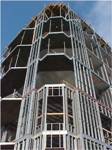
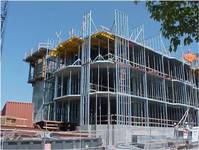
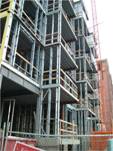
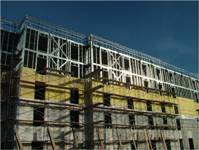 Photos are provided by Don Allen, P.E.

