|
|
|
professor ben schafer's thin-walled structures research group - johns hopkins university |
|
Menu:
input screen
properties and applied loading screen
post-processing results screen
input screen with new cFSM on
classification results in post-processor via cFSM
model results for D only analysis in post-processor
|
CUFSM Elastic Buckling Analysis of Thin-walled Members
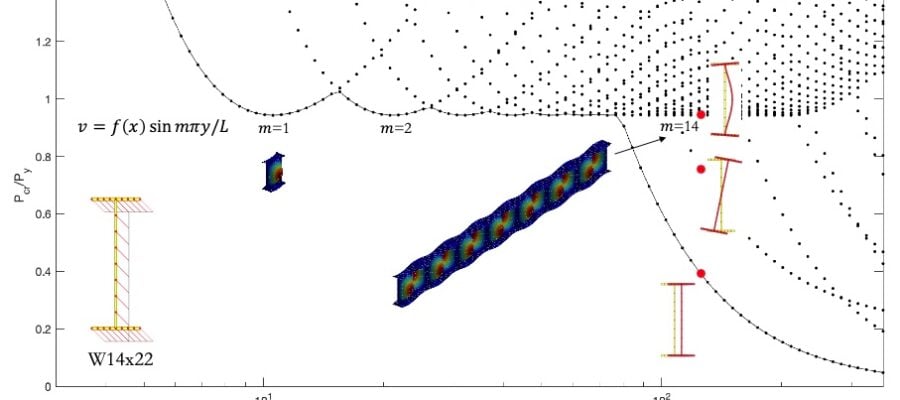
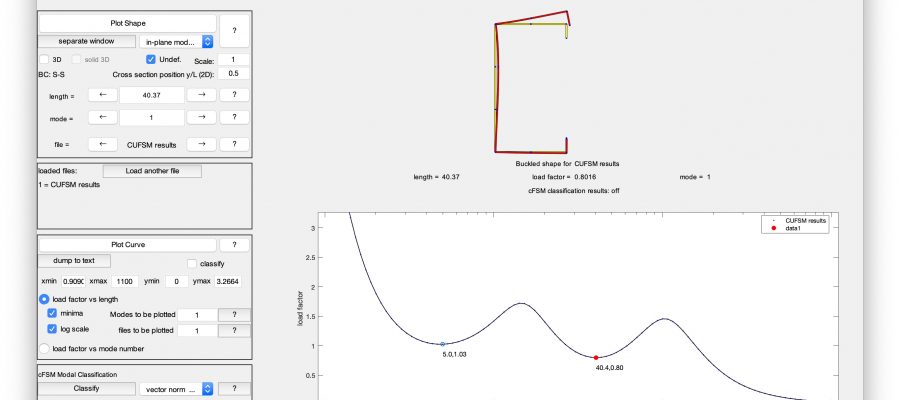
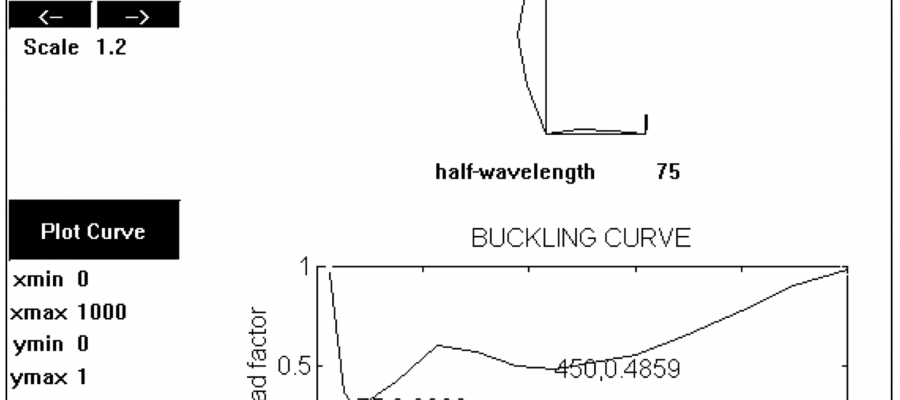
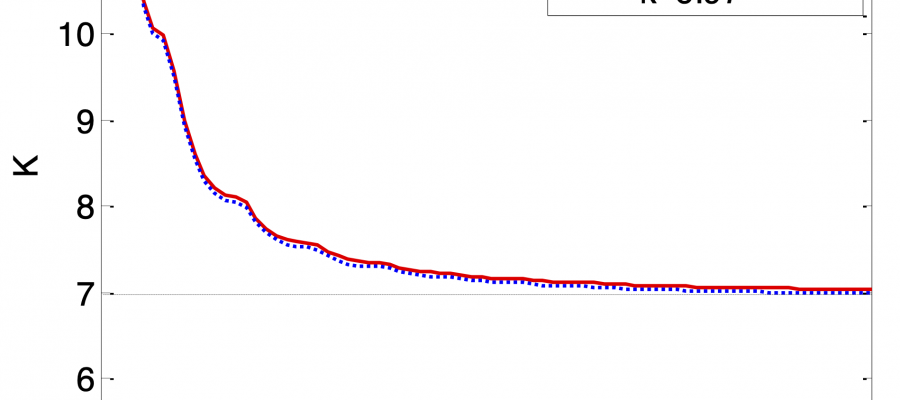
Thin-walled members, by their very nature, have the potential to suffer from a variety of cross-section stability problems. CUFSM employs the semi-analytical finite strip method to provide solutions for the cross-section stability of such members. The software has been successfully used by researchers, educators, students, and practicing engineers. While CUFSM is most commonly used for thin-walled cold-formed steel members, it has also been used for a large variety of other materials and applications.
Find the local, distortional and global buckling load of your member now! Use CUFSM.
Background
What's new (version 3.12)
The constrained finite strip method, or cFSM for short, is a new extension to the finite strip method which provides the ability to decompose stability solutions into contributions consistent with local-plate, distortional, and global deformation modes. Further, general analysis may be identified as containing certain percentages of each of the possible deformation modes. This new extension, now implemented and shared in CUFSM, provides users with an entirely new tool for exploring cross-section stability. The cFSM implemented in CUFSM is discussed briefly in this paper and the cFSM idea is also discussed further here.
CUFSM 3.12 Tutorials Download all hyperlinked tutorials in ppt format (start with the table of contents!) Download all tutorials without hyperlinks in pdf format Download all related CUFSM .mat tutorial files Download individual tutorials only (see below) Frequently Asked Questions - What is CUFSM? Why use it? (ppt) (pdf) Overview of CUFSM features (ppt) (pdf) Tutorial 1 - Learn the basics and interpret results (ppt) (pdf) Tutorial 2 - Build a model from scratch and find Pcr (ppt) (pdf) Tutorial 3 - Build a model using the template and find Mcr (ppt) (pdf) Advanced Functions - B. conditions, springs, constraints, cFSM (ppt) (pdf) Advanced Ideas - Defining buckling modes, higher modes.. (ppt) (pdf) Advanced Matlab - Calling CUFSM from your own code (ppt) (pdf) (m-file) Theory - Background to finite strip and constrained finite strip (pdf) Thanks to Zhanjie Li for updating the tutorials to version 3.12! For earlier versions, including tutorials, see the archive.
Download
CUFSM version 3.12
Installation:
unzip the files to the directory of your choice. To run in matlab open
the file cufsm3.m and then hit the run button on the toolbar in the
matlab editor, OR, change directory in matlab to the directory you
unzipped the files into by selecting the "..." button after the current
directory listing, and then type "cufsm3" in the command window.
Referencing CUFSM
Schafer, B.W., Ádány, S. “Buckling analysis of cold-formed steel members using CUFSM: conventional and constrained finite strip methods.” Eighteenth International Specialty Conference on Cold-Formed Steel Structures, Orlando, FL. October 2006. (pdf)
Direct Strength Method
CUTWP is an elastic buckling analysis tool employing only classical theory. Therefore classical global flexural-torsional buckling solutions can be readily obtained while ignoring cross-section distortion associated with local or distortional buckling. The CUTWP tool may be downloaded from this web site: CUTWP homepage.
All older versions of CUFSM, including supporting materials are available in the archive. Note CUFSM v2.5 and v2.6 provide standalone versions that run well on older PCs.
Note, the materials developed to support CUFSM and the program CUFSM were both developed, in part, through the sponsorship of research projects with the American Iron and Steel Institute ( www.steel.org ) and the National Science Foundation ( www.nsf.gov ). Any opinions, findings, and conclusions or recommendations expressed in this material (or through this software) are those of the author and do not necessarily reflect the views of the National Science Foundation or the American Iron and Steel Institute.
|
|
05/06/08 - schafer@jhu.edu - |