

Research Activities
Project Closes Out
December 2015: The CFS-NEES project officially closed out in December of 2015. The publications page of this website provides links to all the developed reports, dissertations and papers. As of December 2015 some papers related to the project are still in preparation, or revision, but all reports and dissertations are final. The publicatons page of this website will be maintained until final papers from the project are published and then will become a static repository for the project.
Major Activities Completed, Modeling Completion Underway
September 2014: Full-scale testing of the CFS-NEES building is complete. Post-processing of primary data from the testing is complete and is provided in the Ph.D. dissertation of Dr. Kara Peterman, and on the NEESHub. A new fastener-based model for predicting CFS shear wall performance is complete and journal articles on this topic are under preparation. Advanced simulation models of the building at all phases of construction are underway. Completion of the models and comparative studies are expected in the Fall of 2014 with the Ph.D. dissertation of Jiazhen Leng. Additional information provided on the Publications page.
Full-scale Testing of the CFS-NEES Building
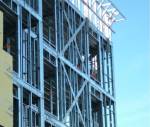
updated July 2013: Full-scale testing and related construction are ongoig at the SEESL lab at the University of Bufalo in the Summer of 2013. Graduate student Kara Peterman is at the SEESL lab for the summer and providing regular (blog) updates of the progress at http://cfsnees.blogspot.com. The Phase 1 testing concluded with a shake table test of the CFS-NEES building under the full-scale Canoga Park record from the 1994 Northridge Earthquake.
Videos: Phase 1 construction, Phase 1 full-scale testing, Phase 1 results from key sensors
CFS-NEES Reserach Reports - providing the backbone for improving CFS Seismic Design
updated January 2013: The over-arching goal of the CFS-NEES project is to better understand the system performance of light (cold-formed) steel framed buildings subject to seismic excitations and to use that understanding to improve design. In particular, the work is intended to lay the necessary groundwork for successful performance-based design of cold-formed steel framed structures. Research on the project is best summarized in the research reports and papers developed from the work as provided on the Publications page.
RR01 provides the archetype structure for the CFS-NEES studies. Complete calculations and drawings are provided. The design represents the state of the art of current practice. The resulting two-story ledger-framed structure will be tested at full-scale in the last phase of the project. See R.L. Madsen, N. Nakata, B.W. Schafer (2011) "CFS-NEES Building Structural Design Narrative", Research Report, RR01, access at www.ce.jhu.edu/cfsness, October 2011, revised RR01b April 2012, revised RR01c May 2012
RR02 provides fundamental work that gives a means to model cold-formed steel beams in a pushover analysis. This modeling is a basic building block for future work. See D. Ayhan and B.W. Schafer (2012). "Moment-Rotation Characterization of Cold-Formed Steel Beams" Research Report, CFS-NEES, RR02, April 2012, access at www.ce.jhu.edu/cfsnees.
RR03 provides shear wall tests on the shear walls utilized in the CFS-NEES building. The tests provide a means to develop simple hysteretic models for use in analysis of the building. In addition the tests included an examination of sheathing details not commonly tested. See P. Liu, K.D. Peterman, B.W. Schafer (2012). "Test Report on Cold-Formed Steel Shear Walls" Research Report, CFS-NEES, RR03, June 2012, access at www.ce.jhu.edu/cfsnees.
RR04 provides cyclic tests on individual fastener-sheathing-stud assemblies. These fastener-level tests are basic building blocks for the primary energy dissipatio mechanism. They have application to modeling of other shearwalls, but also to modeling the diaphragm and even gravitt-framed walls. See: K.D. Peterman, B.W. Schafer (2013). "Hysteretic shear response of fasteners connecting sheathing to cold-formed steel studs" Research Report, CFS-NEES, RR04, January 2013, access at www.ce.jhu.edu/cfsnees
Work is currently ongoing in
Modeling the CFS-NEES building
Testing joist-to-ledger connections
Preparing for the full-scale testing at UB-NEES.
Design of the Prototype Two-Story Cold-Formed Steel Structure for Experimental Investigation
updated June 2012: The over-arching goal of the CFS-NEES project is to better understand the system performance of light (cold-formed) steel framed buildings subject to seismic excitations and to use that understanding to improve design. In particular, the work is intended to lay the necessary groundwork for successful performance-based design of cold-formed steel framed structures. Research on the project is best summarized in the research reports and papers developed from the work as provided on the Publications page.
To date, a two-story cold-formed steel framed arechetype building dubbed the CFS-NEES building has been professionally designed. Cyclic (CUREE protocol) shear wall tests based on the details of the CFS-NEES building have been completed and characterized appropriate for advanced computational modeling. In addition cyclic (CUREE protocal) connector tests also based on the CFS-NEES building details have also been completed. Parallel to this effort a three-dimensional OpenSees model of the CFS-NEES building, appropriate for lateral analysis, has been developed. The model is being used to help develop details related to full-scale shake table testing of the CFS-NEES building which is scheduled to initiate in March 2013.
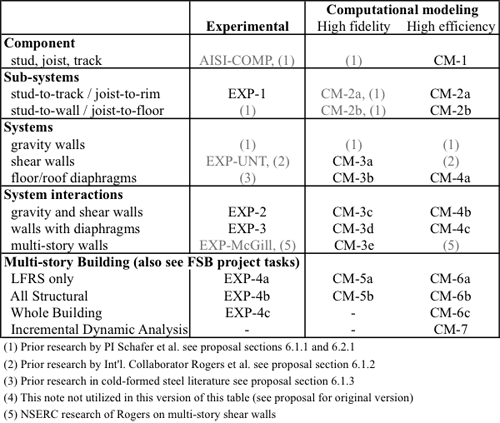
Mapping of Major Tasks in CFS-NEES Project
The major research tasks as envisionsed in the project proposal are summarized here:
Experimental Tasks
EXP-1: Stud-to-track and joist-to-rim sub-system characterization
EXP-2: Wall lines with gravity and shear walls, interaction, behavior, and characterization
EXP-3: Shear wall with floor diaphragm, interaction, behavior, and characterization
EXP-McGill: Multi-story shear wall, shake table dynamic response, behavior and characterization
EXP-4: Multi-story building, shake table dynamic response, behavior and characterization
Computational Modeling Tasks
CM-1: Frame element for thin-walled CFS members/components
CM-2: Phenomenological connection elements for CFS sub-systems
CM-3: High fidelity modeling of walls and diaphragms, supporting testing and characterization
CM-4: High efficiency wall & diaphragm models built-up from component & sub-system models
CM-5: High fidelity whole building models, supporting testing and characterization
CM-6: Validation of high efficiency models for whole building modeling of multi-story CFS
CM-7: Incremental Dynamic Analysis and Performance-Based Design demonstration

